

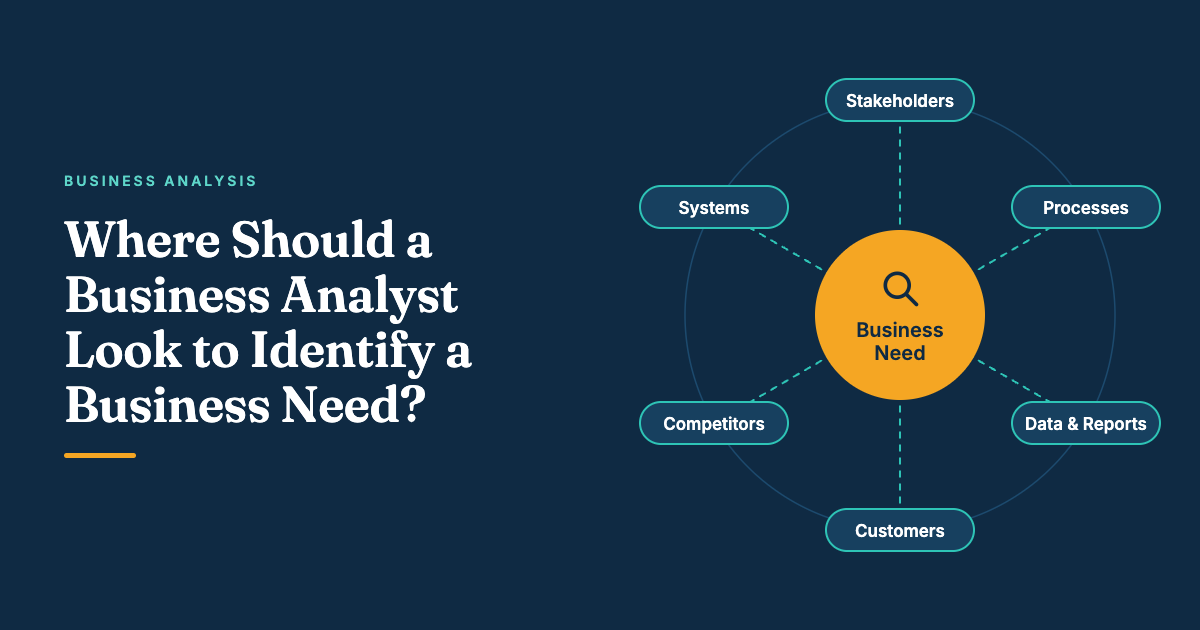
A business need doesn’t always come from the same place. Sometimes, leadership sets a strategic goal. Sometimes, employees struggle with a process every day. Other times, managers identify performance gaps, or external changes force an organization to adapt.
For a Business Analyst, understanding where a need originates helps determine what to investigate, which stakeholders to involve, and what questions to ask.
Let’s look at four common starting points.
1. Top-down: Starting with strategy
Imagine a university sets a strategic goal to improve student satisfaction and retention. Leadership believes the student support experience needs improvement and proposes a new student services portal.
Should the BA immediately start gathering requirements for the portal?
Not necessarily.
The BA first needs to understand the business need behind the request. Are students struggling to find information? Are inquiries taking too long to resolve? Is there evidence that the current process is affecting student satisfaction?
The goal is to connect the strategic objective to a specific business problem or opportunity before exploring solutions.
2. Bottom-up: Starting with operational pain points
Now imagine student services employees spend hours forwarding inquiries to the right departments. They maintain spreadsheets to track unresolved requests because the existing process doesn’t give them enough visibility.
These employees raise the issue with their manager, who asks for help improving the process.
The BA could use stakeholder interviews, observation, and process modeling to understand where the breakdowns occur and why workarounds have become necessary.
The underlying business need might be to improve inquiry routing and establish a consistent way to track requests.
The takeaway: Workarounds are useful clues, but investigate their root causes before recommending a solution.
3. Middle management: Starting with a performance gap
A department director notices that student complaints about increasing delays in responses. However, different departments measure response times differently, making it difficult to compare performance.
The director requests a dashboard.
Before gathering reporting requirements, the BA should investigate how performance is measured, whether the data is reliable, and whether departments follow consistent processes.
The real need might be standardized performance measures and better accountability, rather than simply a new dashboard.
The takeaway: A requested deliverable isn’t necessarily the underlying business need.
4. External drivers: Starting with a change outside the organization
Suppose new accessibility requirements prompt a university to review its digital student services.
The initial suggestion might be to redesign the website. But the BA first needs to understand the applicable requirements, assess the current state, and identify the gaps that need to be addressed.
The resulting need could involve changes to content, business processes, technology, or a combination of these.
The takeaway: An external driver explains why change may be necessary, but it doesn’t automatically determine the solution.
Bringing the perspectives together
These four starting points aren’t mutually exclusive.
Leadership may want to improve student satisfaction, employees may struggle with inquiry routing, managers may lack reliable performance data, and external requirements may create additional obligations.
Each perspective reveals something different about the business.
By connecting these signals, the BA can develop a more complete understanding of the current state and the changes needed to achieve the desired outcomes.
When starting a new initiative, consider asking:
- What strategic objective are we trying to achieve?
- What operational problems are employees experiencing?
- Where are the performance gaps?
- What external changes are creating risks or opportunities?
- What evidence supports the business need?
The answers may reveal one underlying problem or several distinct needs.
Identifying a business need isn’t just about understanding who requested the project. It’s about understanding why change is necessary and what evidence supports it. That’s how BAs move beyond gathering requests and help organizations solve the right problems.